
What’s changed in the utility industry
Utilities must operate, serve customers, and make decisions in real-time. Today’s customers are increasingly looking for answers through digital channels, turning to apps, portals, chats, and dashboards. Expectations for billing transparency, real-time consumption information, and seamless self-service answers are higher than ever.
Customer expectations are rising and utilities must elevate the experience
“Grand Prairie is on the move. Our customers and city leaders have big plans, and we needed to elevate how we serve our utility customers: smarter, faster, and with greater transparency. This transformation helps us meet today’s customer expectations and positions us for continued growth.”
At the same time, utilities are navigating a series of compounding market realities. As experienced staff retire, utilities must balance the transition of deep institutional knowledge while embracing new ways of working that today’s utility staff expect.
Utility organizations can’t rely on outdated systems
Outdated Customer Information System (CIS) software turns simple tasks into multi-step processes to answer a customer question, requiring jumping between vendor tabs, opening multiple screens, and clicking through buttons. Today’s utility staff expect intuitive, process-driven workflows designed for operational efficiency and productivity.
And then there are tighter, more detailed regulations, which mean utilities are under greater scrutiny from both public officials and regulators, demanding timely, accurate, data-driven visibility and answers.
Many utilities are investing in Advanced Metering Infrastructure (AMI) systems for real-time data and insights. But without a modern CIS (the core of your meter-to-cash process and a single source of truth connecting your people, processes, and systems) those investments fall short.
A modern CIS to address customer and staff demands
With today’s rapidly evolving market dynamics, your CIS can no longer stand still. A modern CIS is essential to addressing your customer service, operational efficiency, and long-term sustainability needs, meeting today’s requirements and future demands. Your CIS must unify your customer service, billing, and operations, delivering the customer experience, staff productivity requirements, and business visibility modern utilities need.
Understanding the true costs of your legacy CIS
Your legacy CIS costs you more than just an annual licensing fee. Outdated tech and operational inefficiencies are like a water or gas leak, small at first, but costly if left unchecked.
The hidden cost of your legacy CIS lies in the manual workarounds, lost productivity, and mounting customer and employee frustrations. Furthermore, the risks from non-compliance and security vulnerabilities are likely to become costly consequences down the line, risks no utility can afford to take.
Customer service and operational costs
How many clicks does it take your Customer Service Rep to answer a customer question about their utility usage? How about a potential water leak or service disruption? Seemingly minor inefficiencies and workarounds compound at scale, increasing call volumes, slowing issue resolution, and wasting valuable staff time.
Legacy CIS often falls short in customer experience, missing features such as proactive notifications, leak alerts, and usage dashboards that empower customers and reduce call volume.
Reputational costs
When your CFO or public official asks for an update on a time-of-use rebate program, it’s often a scramble to find the right answer. Data resides across different systems, reports don’t align, and staff piece together spreadsheets to find an answer. But often, those answers are incorrect or incomplete. Utilities operate increasingly complex rate structures, and small billing errors and reporting inaccuracies can erode customer trust, leading to misinformed decisions and reputational harm.
Legacy CIS often lacks the flexibility and controls to support today’s complex rate structures.
Security and non-compliance risks
Delaying that CIS upgrade? CIS upgrades are frustrating, time-consuming, and expensive, especially when they’re vendor-driven and out-of-cycle. But delaying an upgrade carries even greater risks to the security of your utility and customer data, as well as potential regulatory non-compliance.
Legacy CIS often relies on outdated security standards, leaving gaps in protection and monitoring, and struggling to keep pace with sophisticated cybersecurity threats and compliance requirements.
Unrealized ROI from tech investments
You’ve invested in AMI for real-time meter data. Or you’re rolling out a cloud-native ERP to streamline billing and financial workflows. But the full potential of these investments only comes when paired with a modern CIS that integrates seamlessly with your core systems and transforms AMI data into real-time insights, analytics, and actionable intelligence for both customers and staff.
Legacy CIS often limits interoperability, preventing data from flowing seamlessly for a single source of truth and visibility into the business.
Legacy CIS limits customer engagement goals
“Our [legacy CIS] severely limited our ability to provide the customer engagement that our city is really focusing on right now… we want to make sure our customers can engage in a way that’s meaningful to them and provides a positive interaction. We have a great customer service team. They understand the utility, what we do, and can answer questions. We want to make sure our future CIS is prepared for that.”
What to look for in a modern CIS
As shared by utility leaders across the Americas. A modern CIS is not just about upgrading technology; it’s about transforming how you work and serve your customers and community. You need a CIS built for how utilities operate to support better customer experiences, more efficient day-to-day operations, and a rapidly evolving industry that requires business visibility and data-driven decision making.
A modern CIS transforms how you serve customers
“We’re not just upgrading technology, we’re improving how we serve our community. This partnership [with SpryPoint] supports better customer experiences, stronger conservation outcomes, and more efficient day-to-day operations as our city continues to grow.”
To get the most from a modern CIS, prioritize these key pillars that drive both immediate value and long-term adaptability.
Continuous innovation and adaptability built into the platform design
Change is constant in the utility industry. If you’re not planning for how your requirements may evolve, you risk investing in another outdated system you’ll soon replace.
A CIS must be adaptable to your immediate requirements and future needs. Consider a cloud-native system that can quickly and securely accommodate workflow and process changes, or new regulations, without business disruptions or added costs.
Cloud-native CIS platforms enable updates, not upgrades, built into the platform for future improvements, rather than the resource-consuming preparation, testing, retraining, and disruptions that come with an upgrade. A cloud-native CIS allows for more frequent releases that deliver incremental value and eliminate interruptions.
Equally important is a CIS with structured release management and client success programs to help you adopt updates when you’re ready and ensure long-term value.
Operational efficiency through streamlined workflows and processes
One of the primary drivers for investing in a transformational CIS is to enable greater efficiency and productivity across utility teams. Your finance, customer service, IT, and field teams should share the same view and data, eliminating operational and process silos. Wasting multiple clicks to prepare a customer bill or check on the status of an account fails to meet customer and employee expectations. That means a process-centric and intuitive user experience should be at the forefront of your CIS requirements.
A process-centric design prioritizes real-world workflows across the meter-to-cash process, accelerating learning and empowering your team to work smarter. It breaks down departmental silos, supports cross-functional collaboration, and provides visibility to streamline recurrent processes, automate repetitive steps, and improve efficiency.
Because streamlined, cross-functional workflows are built into the modern CIS, configuration (rather than endless customizations) is another critical requirement. Highly customized workflows from legacy CIS systems are well-intentioned, but soon become a source of frustration and delays when every code change or upgrade breaks your workflows and requires downtime.
A configuration-over-customization approach empowers utilities to adjust workflows and processes, enabling you to move at the speed of your business and customer service requirements while ensuring consistency, reliability, and efficiency in an increasingly complex meter-to-cash lifecycle.
Built-in configuration management allows you to adapt your business processes to your evolving needs without locking you into customized processes that may not suit your utility in the future.
Interoperable with core systems for seamless workflows and real-time data
You’ve invested in systems and tools to transform your utility, 15+ for most utilities. Legacy platforms relied on an all-in-one architecture or third-party-supported integrations to create interoperability and a seamless flow of data. But modern, cloud-based platforms are different. APIs and cloud integrations ensure interoperability and seamless data flows, enabling real-time data sharing across platforms and tools for connected workflows, processes, and visibility.
Your CIS is at the core of your meter-to-cash process. A modern platform connects with your customer portal, work order management solutions, AMI, payment systems, and other tools to support a unified meter-to-cash process.
Many utilities have selected, are planning to select, or currently undergoing legacy ERP transformations. Your CIS must seamlessly integrate with your ERP to eliminate operational silos and manual reconciliation, enabling streamlined utility billing, efficient financial workflows, and real-time data insights. When your ERP and CIS work hand in hand, you gain the operational rigor your teams need and the ease of use your customers expect.
The result: stronger financial integrity, accurate and auditable reporting, and enhanced business visibility across the organization’s front- and back-office operations.
Single source of truth, analytics, and business visibility
With new, detailed regulations and reporting requirements, a modern CIS centralizes your data, enhances collaboration and decision-making, and improves business visibility, ultimately improving the customer experience.
Your CIS becomes the single source of truth for all stakeholders, interoperating with your core systems, delivering built-in analytics and dashboards to support:
- Cross-utility performance analytics
- Business and operational performance metrics
- Customer account, service, and billing information, answers and insights
- Field operations, asset management, and productivity reporting
- Financial and business metrics
This level of clarity provides utility accountability and transparency, building trust both inside and outside the utility.
As Mark Moore, Utility Controller for the City of Fairmont, explained after implementing AMI and the SpryPoint Platform:
“I can tell the public commissioner or council exactly where we stand on key business, customer, and operational metrics. I now sleep well at night.”
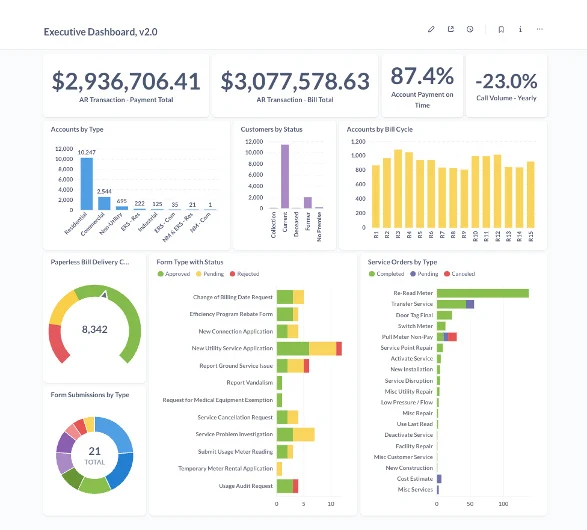
Here’s an example of an executive dashboard, answering business questions such as:
- What’s our total annual billing and payment revenue?
- How many accounts pay on time?
- How many customers enroll in paperless billing?
- How efficiently does my staff support service orders?
Security, scalability, and reliability
Security, scalability, and reliability to grow with your business while maintaining trust and compliance. Customer trust is foundational to utility relationships. Utilities handle highly sensitive customer data, and customers expect them to safeguard it at all times. That’s why you need a CIS with the highest levels of security and reliability built into the platform and its processes.
But most importantly, does your CIS vendor have a security-first approach with continuous, automated updates that deliver the latest protections without requiring a significant upgrade cycle? A security-first approach prioritizes and proactively considers potential threats as an integral part of the decision-making process for every deployment and update, safeguarding data. It’s a critical capability of a CIS to provide peace of mind and avoid the reputational harm that could result from a security breach.
Choosing the right CIS partner
A new CIS can be a decades-long investment. That’s why having the right CIS partner is just as important as the software and technology.
The right CIS partner is a long-term partnership
“No utility team wants to change systems without careful consideration of the complexity involved. The partnership and trust we built with the SpryPoint team, combined with the modern technology we have implemented, created a positive experience for our staff and better service for our customers.”
Before committing to a new CIS platform, consider the following factors to ensure your CIS partner is the one you want to commit to long-term:
- You want more than a tech vendor; you want a partner who understands the utility industry and has proven success helping utilities navigate the transformational process, change management, and staff enablement that come with a new CIS.
- You want a partner with a consultative approach to your business process transformation, implementation, and change management requirements before, during, and long after implementation to ensure you maximize the value of your CIS investment.
- The business transformation that comes with a CIS doesn’t end at go-live. Choose a partner that has a reputation for long-term, continuous support beyond implementation as your business evolves.
- You’ve checked the box on a modern CIS, but that doesn’t mean your business stands still. You need a partner with a record and culture of continuous innovation to meet today’s requirements and anticipate your future needs as your business grows.
Building a hub of opportunity for customers with the right CIS partner
“The vision within our strategic plan is focused on creating a ‘hub of opportunity’ for all citizens, but the lack of modern systems and services was holding us back. SpryPoint is the perfect fit to deliver on our goal of modernizing operations and technology to be a well-run city, meeting today’s requirements while providing a solution that will grow with us.”
Lead your CIS transformation with confidence
The transformational change that comes with a modern CIS is a necessary one as your utility evolves. Delaying it only increases the future complexity and risk as you contend with the rapid pace of transformation and customer demands. And the hidden costs quietly erode efficiency, productivity, trust, and the value of your other systems every day.
Transformational change is an opportunity to lead an initiative to modernize your utility and leave a legacy for your staff and your community. By choosing a modern CIS with built-in future enablers, your next CIS project could be the last one your utility ever needs.
The right CIS partner can help you navigate the requirements, the immediate and future demands, with confidence.
Change is hard; the right partner makes the difference
“Change is difficult. It’s expensive. Oftentimes, you’re wearing two hats. And so when you make that commitment to have a partner walk alongside with you, and then have that energy through the life of the project and beyond, it’s impactful.”